Emerging writers review major exhibition ‘Slow Read'
Students of the Diploma of Professional Writing and Editing course at Swinburne University of Technology have completed reviews of the most recent major exhibition at Town Hall Gallery, ‘Slow Read’, as part of their classes on arts criticism. A selection of writings from the class can be found below.
‘Slow Read’ can be viewed on our Online exhibitions page.
Image: Installation view, 'Slow Read', Town Hall Gallery, 2026. Photography by Christian Capurro. Pictured is artwork by Gracia & Louise.
Reviews
Selected excerpt from “Finding Stillness at ‘Slow Read’”:
I've always enjoyed galleries because they rarely expect everyone to see the same thing. Two people can stand in front of the same work and leave with entirely different experiences, and neither of them is necessarily wrong. ‘Slow Read’ embraced that beautifully. Rather than directing me towards a single interpretation, it invited curiosity, rewarding every return with another small detail I'd somehow missed the first time.
I realised I didn't need to understand everything immediately.
Some things reveal themselves slowly.
Books do that.
People do that.
Good art does too.
Deborah Kelly's work lingered with me for entirely different reasons. Where Martin King's books asked me to sit quietly with time, Kelly's textiles refused to be ignored. They were bold without feeling loud. Delicate, yet strangely commanding. One figure stood impossibly tall, crowned with what looked almost like an explosion of native flowers. Another seemed to dissolve into birds taking flight. The woven surface caught the light differently every time I moved, reminding me it wasn't a painting at all, but thousands of threads patiently brought together. From a distance they appeared monumental. Up close they became surprisingly delicate. Figures emerged from richly woven fabric, standing with a quiet confidence that felt both mythical and unmistakably human. I kept returning to them anyway.
Standing there, I realised I wasn't trying to interpret them as much as I was responding to them. They felt unapologetically feminine, not in a fragile or sentimental way, but in one that celebrated strength, autonomy and individuality. There was something wonderfully eccentric about them too. They seemed completely comfortable occupying their own space without asking permission or offering explanation.
I found that strangely refreshing.
As I wandered back through the gallery one last time, I realised I wasn't taking photographs anymore. I was simply looking.
I'd arrived expecting to review artworks.
Instead, I'd spent an afternoon reconsidering my relationship with books, memory, language and the rare act of standing still.
That's what stayed with me most.
Looking around the room one last time, I realised nobody was standing in the same place for very long. Some lingered in front of Martin King's books. Others barely glanced at them before disappearing into another room. A few stood reading every label. Others simply looked. It struck me that we had all walked through the same exhibition, yet each of us would leave carrying something entirely different.
As I left, I wasn't thinking about which piece I'd liked best. I was thinking about how differently I'd moved through the gallery compared to how I'd walked in.
In a world that constantly encourages us to move faster, read quicker and consume more, ‘Slow Read’ quietly offers an alternative.
As I stepped back into the afternoon, the traffic hadn't changed.
My phone still buzzed.
The world was moving just as quickly as it had when I'd arrived.
I was the only thing that had slowed down.
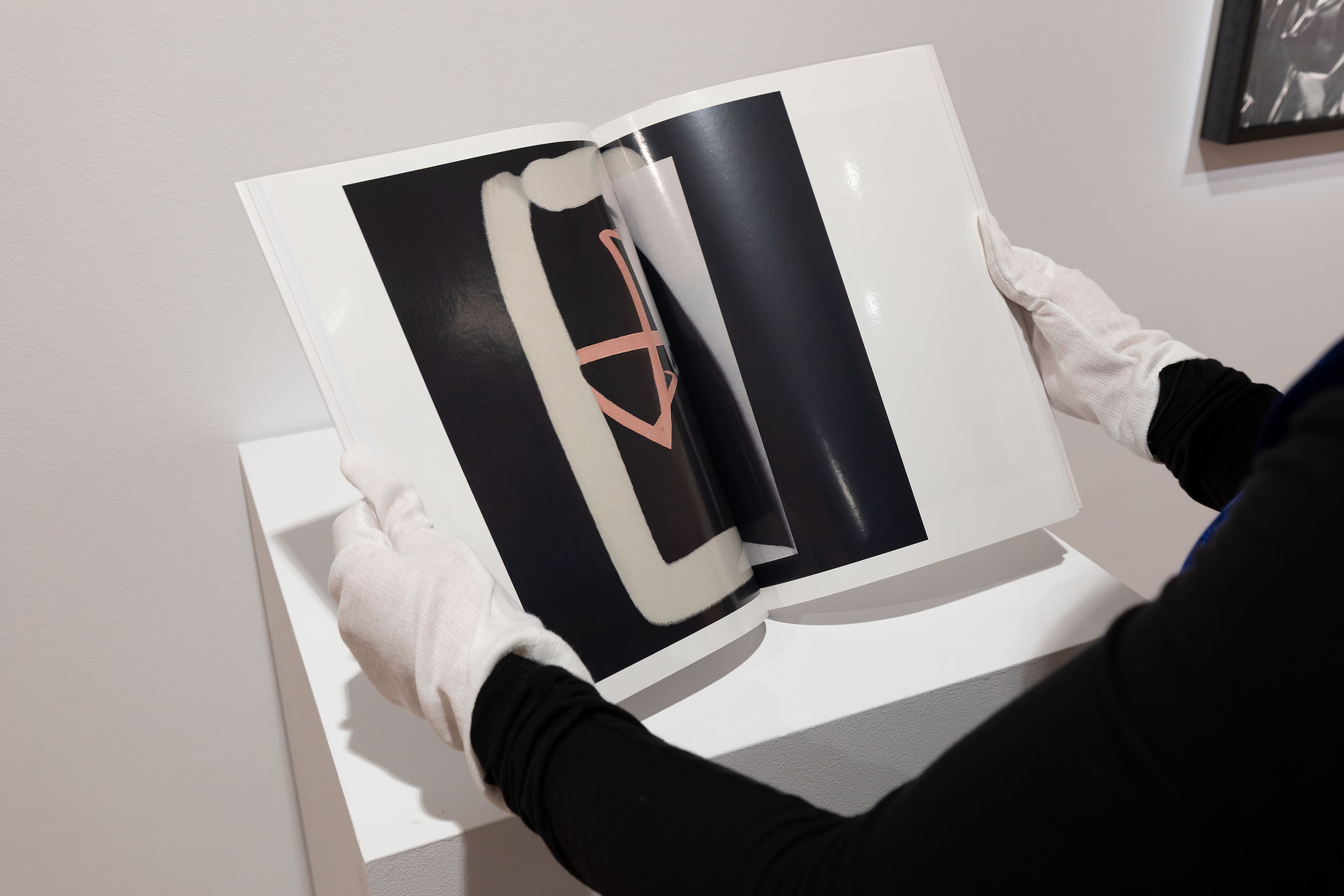
In response to Zoë Croggon’s ‘How to Cut an Orange’, Lia Alvarez writes:
In her highly anticipated second artist’s book, ‘How to Cut an Orange’, Melbourne-based artist Zoë Croggon compiles nearly a decade of striking photographic collages. Known for her profound exploration of the kinetic body, performance, and modern architecture, Croggon’s practice is deceptively minimal but deeply complex. She strips the collage format down to its bare essentials, working with decisive, singular cuts or sculptural folds that completely reframe the original images.
The physical presence of the book immediately establishes this tension, as captured in the photo. The cover art presents a mesmerising black-and-white composition that perfectly embodies Croggon’s signature style of space and form. On the lower half of the frame, a draped figure curves elegantly against a dark backdrop, an arm reaching upward to rest against a stark, geometric boundary.
Above this form, the image fractures into an intense field of horizontal distortion lines. The effect is optical and hypnotic, mimicking the ripples of a kinetic frequency or a deeply compressed digital glitch. By splicing the classical texture of draped fabric with these jarring, architectural lines, the cover serves as an immediate visual thesis. It highlights the constant dialogue between the organic human body and the rigid structures that contain or frame it.
'How to Cut an Orange’ distinguishes itself by anchoring its imagery in literature and written language. The publication features an incisive, abstracted essay by poet Samantha Abdy that meditates on what it means to be a spectator possessing a body in the world. It also includes a moving selection of poems by Croggon’s mother, the renowned cultural critic and poet Alison Croggon.
This collaborative framework gives the book an introspective yet outward-gazing narrative rhythm. The "cut" becomes more than just a physical gesture on paper; it represents a sharp, precise translation between language, flesh, and archival memory. Ultimately, ‘How to Cut an Orange’ is a masterclass in editorial design and artistic restraint. For an archive of work that spans nearly a decade, the book feels remarkably cohesive and immediate, challenging the viewer to find the hidden choreography beneath the blade.
Image: Installation view, ‘Slow Read’, Town Hall Gallery, 2026. Photography by Christian Capurro. Pictured is ‘How to Cut an Orange’ (2024) by Zoë Croggon.